Opera is one of the last quality films directed by Dario Argento before he decided that making crap would be better for his career. While the third act is rather sloppy, the rest of the film does a good job of keeping the viewer engaged with red herrings and quality murders that effectively raise the tension, as compared to some of Argetno's previous works.
Opera begins with an elaborate tracking shot, that appears to be the POV of an opera singer, but as if her eyes were in the back of her head. This instantly creates a mild disorienting effect in the viewer. The source of the shots perspective is never revealed, nor is the face of the woman who we are apparently following, leaving us only her voice. She is angrily leaving the opera house because she does not like working with the live crows in the theater. As she walks out she is hit by a car and critically injured. This leads to the production company promoting the understudy, Betty, to the lead of Verdi's Macbeth. A string of murders follow, naturally, but Argento adds an interesting twist to his formula this time around.
It seems that Betty will be the first of the characters to meet their end, but the killer instead ties her to a pillar and tapes a line of pins under each of her eyes. He tells her she must look, or her eyes will be torn off. When someone comes to her help, the killer appears and stabs him to death. Betty is then cut loose, but the murderer is no where to be found.
Don't close your eyes.
The eye-pin mechanic adds a great level of previously lacking tension to the murder. Usually in an Argento film the audience knows that once the knife is out, the poor soul is done for, but here the deaths are not so much about the victim, but the witness, Betty. We feel each of the cuts to closeup of her eyes, as the killer digs his knife into his victim. Unfortunately, Argento uses this setup in almost every death scene in the film, so upon repeated usage it loses almost all of its impact since we know she is not in any real danger.
As suggested already, eyes and vision are a major theme throughout the film. We begin with the tracking shot from a mysterious perspective, and we have our heroine witness each of the murders in a grizzly manner. Shots of closeups on the eyes of crows is a recurring image as well, and a POV shot of a crow is used for an elaborate crane shot at the end of the films second act. Finally, when the murderer is revealed, it is his eyes that are attacked, with one of them being pecked out and eaten by a crow. Argento is perhaps reflecting on the controversy that has always surrounded his films, and his audiences love looking at them.
The acting in Opera is pretty bad across the board, without a single character really giving a believable performance. This is surprisingly easy to look past, however, due to the good pacing of the film and constant teasing of who the killer actually is. The third act is really rather bizarre. I'm not sure if it is terrible, or just strange. The last ten minutes without a doubt is the worst part of Opera, but it isn't so bad that it ruins the whole thing. It just leaves one scratching their head a little.
With Mario Bava'a son, Lamberto Bava, directing, Dario Argento producing, and a script penned by Bava, Argento, Franco Ferrini, and Dardano Sacchetti, my expectations for Demons were somewhat high. Unfortunately, there is not very much to Demons, and the stale characters and thin plot lead to more yawns than shocks.
The film follows a university student named Cheryl, who receives a free ticket to a film screening at a newly renovated movie theater. She goes with her friend, Kathy, and it turns out that tickets were distributed to folks throughout the city. The screening is of a horror film dealing with some sort of mask that turns people into demons. The same mask was on display in the theater lobby, and one women is scratched by it. She becomes a demon and then attacks people, who then also become demons. It's essentially a zombie premise, but without the undead factor. However, if I understood correctly, the theater itself is the source of evil, not the mask, but that is never explained past a character suggesting the idea.
On paper, Demons plays out much like Night of the Living Day (1968). A simple narrative structure, where a group of people are trapped and need to work together to survive. The issue is that everything that happens between demon attacks is completely uninteresting and lacks any sort drama or intrigue. The cause for most of these problems rest in all of the characters within the film. Not only did I not care about them, I actively disliked them. Instead of feeling suspense for their survival, I was praying for their deaths. It's as if someone gathered together all the most popular students at Miami of Ohio and put them in a movie. The one exception is a pretty racist portrayal of a black pimp who takes on the role of group leader early in the film. This guy is so over the top and ridiculous that one just has to love him.
The monster effects are quite good, and satisfyingly graphic. There are multiple shots that encourage vocal reactions from a viewer, and the scene where a character is shown transforming into a demon is particularly good. The music is another strong point, featuring electronic tunes, in addition to rock and heavy metal songs. The music is lively and fun, and certainly gives some of the sequences an added charm.
Ultimately, however, I couldn't help but feel bored while watching Demons. The effects are nice, but Bava's directing is pretty poor, with sloppy blocking, bad acting, with most scenes lacking any sort of gravity. The one exception is a scene where one of the characters rides around the theater on a motorcycle wielding a katana. Demons is worth watching just for that scene.
So here it is:
Inferno (1980) Director: Dario Argento
After not being satisfied with Demons, I decided to watch Argento's film Inferno, a spiritual sequel to Suspiria. The film is the second entry in Argetno's Three Mothers trilogy, with The Mother of Tears (2007) being the third and final installment. While perhaps not as bombastic and striking as Suspiria, Inferno is still a great horror film that has plenty of visual flair and mystery throughout.
The film centers on American college student, Mark Elliot, investigating the mysterious disappearance of his sister in New York City. What he finds is that there is a powerful witch pulling the strings behind everything. Not terribly complicated or nuanced, but the mythology behind the three witches that the audience is given at the beginning of the film ,and built on throughout, is quite interestingm and becomes the most engaging aspect of the story.
In Suspiria the main color motif was red, while Inferno's is blue. The blue creates a much colder feeling in the look of the film, and also a more enigmatic and surreal quality. While Suspiria certainly appeared dreamlike, Inferno takes this even further. The sets that the film were shot on look like sets and one does not actually feel like the film is set in New York. This is a strength, not a weakness, because one truly feels as if they have been transported to some strange world that does not abide by the normal laws of nature. The light sources are often inexplicable, giving different shades of blue to rooms. The entire apartment building is part of the witch, Mater Tenebrarum, and the artificial and overtly constructed nature of the mise-en-scene works to evoke this feeling of a supernatural presence.
The score was not composed by Goblin, which is certainly a disappointment, and Keith Emerson's score creates a markedly different tone. This was intentional on Argento's part, and it is clear that he is trying to work against some of his fans' expectations, especially by not killing a character until 35 minutes into the film. Still, the score simply is not as affecting as the ones by Goblin, although there is one track that is balls to the wall awesome.
Suspiria is set in Munich, Germany, and most of the deaths take place within an interior space. All but for one death, the blind piano player. In addition to being the only exterior death, the scene also has the blandest color pallet, consisting mostly of grays. Also, unlike the other murders, this one is not committed by the mysterious knife wielding hand. Instead, the man's dog turns on him. The interior environments are lush with color and appear surreal, and the murders are committed directly by a hand of the which, while the exterior one requires an assistant, in this case the dog. These stylized interiors can be seen as a sort of surreal world, one existing outside of a parallel real world.
The real world consists of the exterior environments, and are gray. The witches do not have direct power/can't exist within the real world, so the dog must be used to commit the murder. And when this man is attacked by his dog and he screams for help, what happens? Nothing. No one comes to his aid. Throughout Argento's films, no one comes to the aid of the victim until it is far too late. No one seems to be able to hear the screams. That, or people are choosing to ignore them.
The significance of the real world environment in Suspiria of Munich, Germany is drawn from the Holocaust. The atrocities of the concentration camps and ghettos were known in other parts of the world, but were ignored until the last moments of World War II. The use of Nobucco in Inferno then continues this theme of the Holocaust by inciting a story about the suffering of the Jewish people. The genocide of the Nazi's is then mirrored in Argento's films with the elaborate senseless killing of innocent people throughout. Since Italy was a fascist ally of the Germans during World War II, this film can be seen as an expression of guilt for not doing something to end the slaughter.
Why witches? No idea.
The greatest issue with Inferno is that the hero, Mark Elliot, is severely lacking in agency withing the narrative. Most events happen around him without him having any direct effect on their consequences. That doesn't detract from the films strengths, however, and this is a horror film that should be seen.
Zombi 2, AKA Zombie, AKA Zombie Flesh Eaters, AKA Woodoo, is, as three out of the four titles suggest, a zombie movie. It was originally released as Zombi 2 even though it is not actually a sequel to any film. George A. Romero's Dawn of the Dead was released in Europe under the title "Zombi" around the time of this film's production. So to cash in on the success of Romero's film, the producers marketed Fulci's zombie flick as a sequel, even though they have nothing in common aside from both having the dead rising from the grave.
Lucio Fulci is infamous for the high level of gore and violence in his films. He is known as the "Godfather of Gore," a title shared by splatter film director, Herschell Gordon Lewis. (Lewis may be best known today for his film, The Wizard of Gore [1970], being featured in Juno [2007]) Zombi 2 is one of Fulci's most well known pictures, carrying his signature level of gore. Blu-ray.com's review of Zombi 2 opens by stating it is
a gore-driven spectacle the likes
of which
are rarely seen even in the Horror genre. The movie has no qualms about
allowing the camera to linger on shots of incredible grotesqueness,
whether
torn flesh, gushing blood, rotten bodies, or popping eyeballs. It's
insanely gory, but it's not exactly frightening.
Essentially, there are two things this movie is known for; the blood and guts, and the fact that there is a scene where a zombie fights a shark.
If you Google Image Zombi 2, the first suggestion is Shark
However, by today's standards Zombi 2 is actually somewhat tame. This isn't to say it doesn't have it's fair share of gore, but I think most modern viewers likely won't be too affected by it, especially those who watch horror films regularly.
The film begins with a seemingly abandoned boat appearing off the coast of New York City. Two cops investigate the boat and find a zombie chilling on board. The daughter of the man who owns the boat is looking for answers, and a pretty ugly British reporter in the city joins her to investigate where her father disappeared to. This leads them to the island of of Matool, where there are a bunch of zombies. Commence slaughter of people.
Looks like she has strip throat...
Zombi 2 is a fun and entertaining film, but certainly lacks impact. The plot is simple both in its structure and thematic nuance, which works to its favor by getting straight to the zombie action, but don't expect anything more than that. This isn't Fellini, now. The gore effects, in general, are solid and effective, but there are two instances when it looks really fake and takes the viewer out of the moment. During the infamous eye scene it becomes quite clear that the woman's head isn't real, and in the scene the above still is taken from, the fake and real skin of noticeably different tones. The zombie makeup is what stood out the most for me. Most of them believably look like they were once dead and have been buried for years. Their skin is worn, worms eat away at them, and they're flesh and limbs are fragile. The carnage is certainly satisfying to the point where I was never bored while watching the film.
In case you were wondering, this eye scene.
The dubbing is pretty bad all around, but it is at a level where it is so bad it's good, so the entertainment value is never lost. The best example comes from a black New Yorker early in the film, whose voice makes Cleveland from Family Guy seem politically correct. There is also some moments of gratuitous nudity, which is nice for those who keep the pause button close at hand while watching these sorts of films.
Overall the film is good, but certainly not great. It's not in the same league as Romero's Dead Trilogy, or some of the other popular zombie films. However, it is without question worth checking out if you are a fan of the genre, or gore films in general.
I have decided that with the plethora of free time allotted by being unemployed, I will attempt the 31 Days of Halloween Movies this October. The rules are simple: watch a horror film every day during the month of October. However, I read this as AT LEAST one movie a day, so I plan to have some big purges on occasion. I did start yesterday, but am doing my first post today, October 2nd.
I also couldn't really wait for October, so I pre-gamed during the last weekend(ish) of September. During those few days I watched the following films:
If you couldn't tell, I was in the mood for Italian horror films. That's how I plan on starting off October, with a wave of Italian horror films, and I wanted to get a warmup/some background on the country's films. Many of the films I plan on watching will be first time viewings (all of the above but Deep Red were), and I look at this as sort of a learning experience. I plan to then pass those learnings to the three people who read this blog. Go us.
Italian Horror
The late 1950s to the early 1990s is sometimes referred to as "The Golden Age" of Italian horror films. Of the early directors, the most highly regarded is Mario Bava. Over the course of his career he worked as a director, screenwriter, special effects artist and cinematographer, often times within a single film. Black Sunday was one of the last great Gothic horror films before he moved onto films that would help lay the groundwork for the later slasher films. Specifically, he formed the template for what is known as Italian Giallo films.
His movies The Girl Who Knew Too Much and Blood and Black Lace are considered to be the earliest examples of the Giallo genre, and where many of the genre's tropes originated. Some of these include a series graphic murders, the murderer being shown as a masked figure of some sort, and the plot revolving around whodunit mystery structure. The term "giallo" comes from the Italian word for "yellow," which was the color of the covers of a series of cheap paperback mystery novels, back in the day.
The most famous and well regarded filmmaker of the Giallo genre is Dario Argento. His films are famous for their stunning visuals and elaborate death scenes. So far I chosen to watch two of his best Giallo films, Deep Red and Tenebre. Of the two, Deep Red is most often cited as Argento's greater film, and I would agree, although Tenebre was enormously entertaining as well. All this, however, was to prepare me for the first film of the month, Suspiria (1977).
Suspiria (1977) Directed: Dario Argento
Still from Suspiria
Before I begin, please watch this:
Is that a trailer, or what?
Most conversations about Argento lead to weather Suspiria or Deep Red is his best film. When I recently watched Deep Red it was my second viewing, and this time the original Italian version versus the truncated English one I saw when I was younger. I enjoyed this second viewing of Deep Red much more, and seeing it on blu-ray was pretty spectacular. It is also worth noting that while Deep Red is a Giallo film, Suspiria is a supernatural horror film, which makes the two quite different experiences. With all that said, I still think I prefer Suspiria (this was my fourth time seeing it), and I will now go on to why I think it is a horror masterpiece.
Suspiria's story is pretty simple, and to many, doesn't actually matter; it's more about the visual experience. For those who do care, the film follows an American girl named Suzy Bannion who travels to Germany to study at a famous dance studio. Lots of people die, she investigates, and finds out the secret of the dance academy. The end.
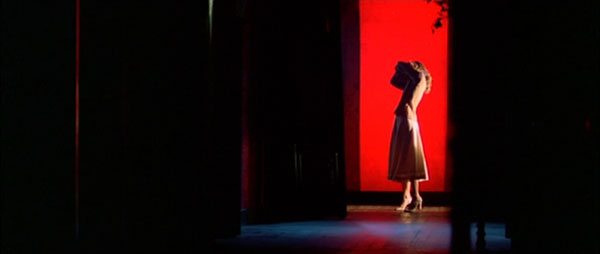
This film is an art director's and cinematographer's wet dream. Just take a gander at that still above. The entire 92 minutes is loaded with one gorgeous shot after the other. Suspira was actually one of the last films to be shot using Technicolor, and being shot with that way makes all of the colors are highly exaggerated, especially red (which plays a strong motif throughout the film, for obvious reasons). What I find most fun and exciting about the film, is that it combines these beautiful compositions with brutal images of death. The result is an interesting "conflict of morality" in the viewer where one finds what's on screen to be aesthetically pleasing, while the content of the frame is horrific. Here is a good example:
Pretty.
This is not the only Argento film to do this. Many of them do, including Deep Red, but Suspiria, I think, executes it the best and to the fullest potential.
Still from Deep Red
Another standout quality of the film is its score, composed by the progression rock band, Goblin, with Argento's collaboration. What I like about this score, and its usage in the film, is that when it comes on, it goes full blast. It becomes kind of unnerving just by how relentlessly the sound plays during a scene. I remember during the first time saw this movie, how struck I was by the opening scene when Suzy is walking out of the airport. The music sharply cuts in and out with the camera switching from POV to tracking shot. In doing this, the music almost takes on a sort of mysterious quality that not only foreshadows the tale to come, but also creates a slight unnerving feeling in the viewer. Goblin also did the scores for Deep Red and Tenebre, and are each wonderful in their own right.
As a piece of art and entertainment, it's hard to top Suspiria. The one flaw in it, in my eyes, comes from some of the dubbing. A few of the minor characters sound really bad, and take me out of the moment. (Side note: All Italian movies are/were recorded without sound and then dubbed over) Other than that small complaint, this is one of the best horror films a fan of the genre could watch.