So for those of you who do not know, The Criterion Collection is, well, here is their mission statement:
Since 1984, the Criterion Collection, a continuing series of
important classic and contemporary films, has been dedicated to
gathering the greatest films from around the world and publishing them
in editions that offer the highest technical quality and award-winning,
original supplements. Over the years, as we moved from laserdisc to DVD,
Blu-ray disc, and online streaming, we’ve seen a lot of things change,
but one thing has remained constant: our commitment to publishing the
defining moments of cinema for a wider and wider audience. The
foundation of the collection is the work of such masters of cinema as
Renoir, Godard, Kurosawa, Cocteau, Fellini, Bergman, Tarkovsky,
Hitchcock, Fuller, Lean, Kubrick, Lang, Sturges, Dreyer, Eisenstein,
Ozu, Sirk, Buñuel, Powell and Pressburger. Each film is presented uncut,
in its original aspect ratio, as its maker intended it to be seen.
Every time we start work on a film, we track down the best available
film elements in the world, use state-of-the-art telecine equipment and a
select few colorists capable of meeting our rigorous standards, then
take time during the film-to-video digital transfer to create the most
pristine possible image and sound. Whenever possible, we work with
directors and cinematographers to ensure that the look of our releases
does justice to their intentions. Our supplements enable viewers to
appreciate Criterion films in context, through audio commentaries by
filmmakers and scholars, restored director’s cuts, deleted scenes,
documentaries, shooting scripts, early shorts, and storyboards. To date,
more than 150 filmmakers have made our library of Director Approved
DVDs, Blu-ray discs, and laserdiscs the most significant archive of
contemporary filmmaking available to the home viewer.
So for an American cinephile, the Criterion releases of films are the best version available for home viewing. As stated above, they offer the best possible video quality, in the correct aspect ration, and offer plenty of supplemental content. Their releases aren't cheap, but they are worth the price. Most of the films in the collection are only available in the U.S. through them. Criterion films also have fantastic cover art. So here is a list of my top ten favorite Criterion covers.
This film is pretty nuts and I'm pretty certain I have little idea as to what happened in it. The cover does a great job of recreating the craziness of the film. Since you (and me) probably want to see this film more than once, owning the Criterion release is a great idea.
I have not seen this film, nor do I have any idea what it is about. But the cover sure does look pretty doesn't it? I'm a huge fan of Lee's Brokeback Mountain and I enjoyed Crouching Tiger, Hidden Dragon, so I will probably give this one a watch at some point.
Rumor has it that this movie is really crazy. The cover itself looks pretty ridiculous. I know nothing about the film other than it is a crazy Japanese horror movie, which is all I need to know going in. Of the four movies on this list that I have not seen,this is the one I need to see the most.
I now realize that there are a decent number of crazy movies on this list. Repulsion is the first in Polanski's apartment trilogy, the other two being Rosemary's Baby and The Tenant. The cover is simple, but effective in representing the psychological state of the main character.
Again, haven't seen it and I don't have a clue what it's about, but look at that cover! It's SO striking! I do know that the director, Nicolas Roeg, was first a cinematography, which lends to the visual strength of the film. The screenshots that I have seen are gorgeous.
This is the last of the crazy films on this list and I think (since I haven't seen one of them) this may be the craziest. It is certainly crazy in its own "unique" way. This film is constantly ranked as one of the most disturbing films ever made and the cover acts as a nice warning.
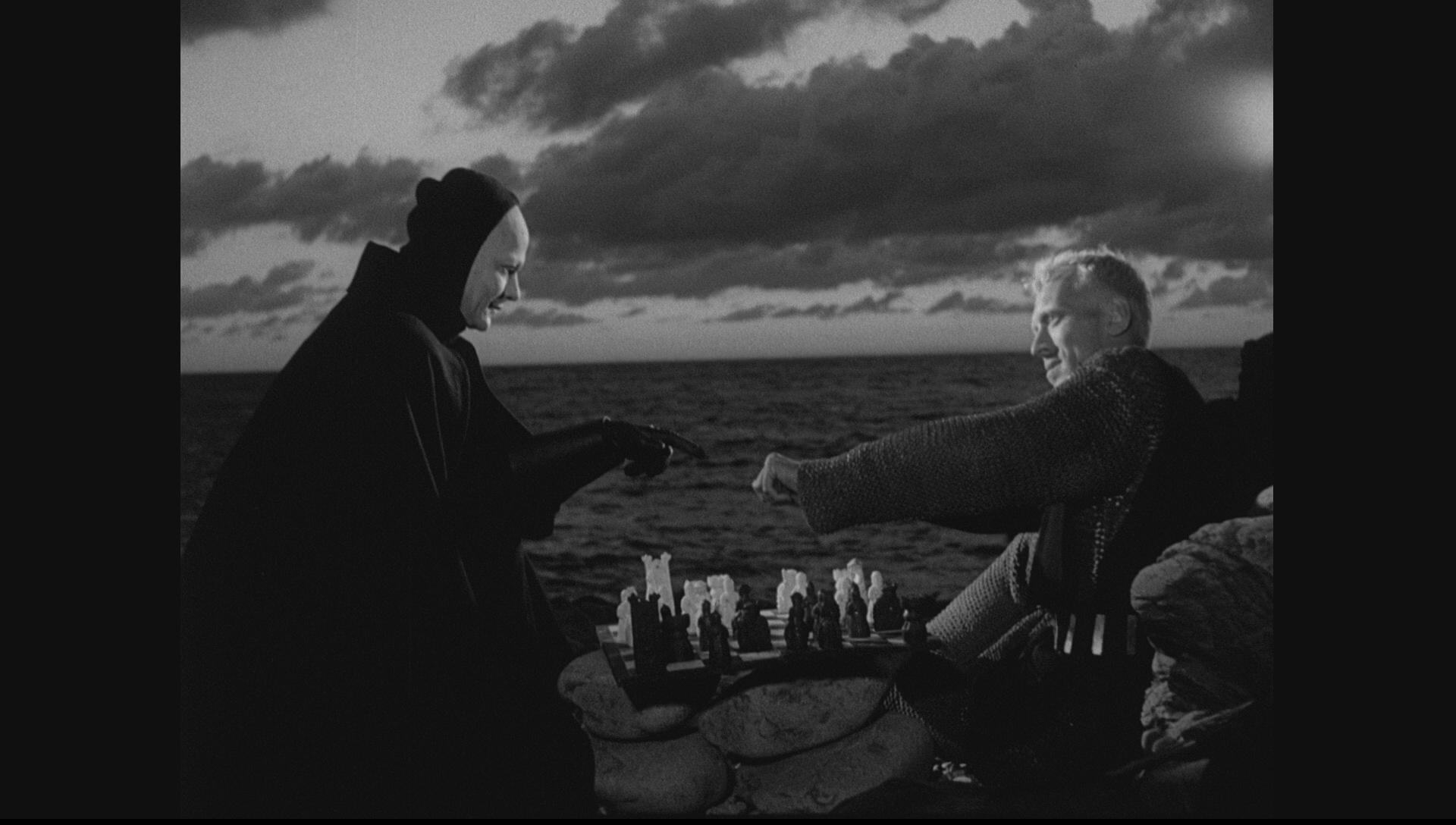
This film contains some of the most powerful images of black and white cinematography and this cover does a good job at capturing the weight of these images. The cover is simple and beautiful, showing the knight's face partly covered in shadow, symbolizing his inner struggle in the film.
2. Seven Samurai (1954): Directed by Akira Kurosawa
I believe Seven Samurai was the first Criterion film I ever saw, and I remember looking at it and being a tad confused as to why it was so fancy. The cover, here, is taken from the image of the Samurai's banner in the film. The six circles represent each of the "true" samurai and the triangle...well, you will just have to see for yourself.
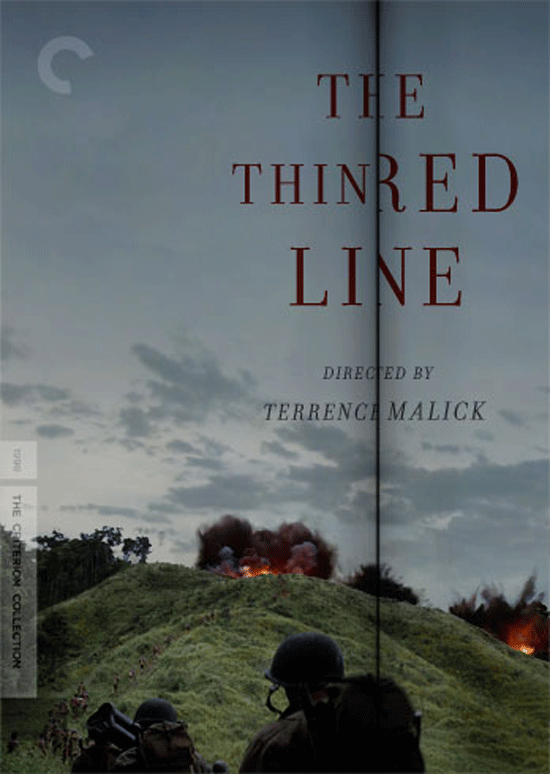
I was in awe the first moment I saw this cover. The actual image itself is beautiful, with the dull green hills, the shaded backs of the soldiers, the explosions in the distance, all against the blue-gray sky. Then there is the thin red vertical line running down the cover making it look like the inside of a book (the film was adapted from a novel). Another great cover to a Malick film is the one for Days of Heaven.
I sometimes hear people complain that there are no good movies available on Netflix streaming. I think we may be using different services, because my instant queue is full (the cap is 500). To help out in finding good movies to watch I have constructed a list of what I believe to be the 15 greatest movies available for streaming on Netflix. These are not my 15 favorites, but what I actually consider to be the best. Since this is still my opinion, I only included films that I have seen. I provided with each film its IMDb and Rotten Tomatoes Rating, as well as its ranking on the latest Sight and Sound polls as a means of evidence for each film's quality.
15. Irreversible (2002)
Starting the list off with a touch of controversy. The film is infamous for its rape scene but its not tasteless (which is kind of weird to say). I can't really say that this movie is for everyone, but for those who can handle it and understand its message, it's a must watch.
If you hate Twilight (which you should) and actually like vampire lore, then it is pretty hard to top this film. I beautifully shot film with a love story we care about; this is vampire romance done well. This film is violent too, but I found the sound effects to be more unsetteling than the images.
I placed this film's ending as my second favorite in my last list and one of the reasons the ending is so effective is due to the quality of the rest of the narrative. Kubrick made this film 11 years before 2001 but Paths of Glory is evidence that he was a genius since his early years.
Some may find this movie "weird" while interesting people will recognize it as surrealist and awesome. The 1960s marked Bergman's transition to modernist narratives and this is one of his greatest efforts. If you like strong images and story that is not too simple, then you will enjoy this.
This was the last grand film directed by Akira Kurosawa and it's clear that he went all out with it. It is a loose adaption of Shakespeare's King Leer and set in feudal Japan. Epic and tragic, this is one of the finest examples of Japanese cinema as done by one of the country's greatest auteurs.
Often hailed as David Lynch's greatest film (I personally prefer Eraserhead), Mulholland Drive is an exceptional example of neo-noir. I would describe the story to you, but I'm not too sure what happened myself.
Much of this film will probably seem familiar to viewers. It has many classic lines of dialogue as well as a narrative technique that influenced American Beauty. Sunset Blvd. is one of the best examples of film-noir from Hollywood's golden period.
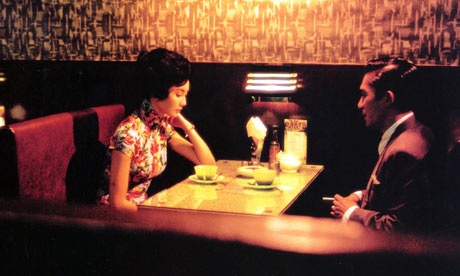
In the Mood For Love is probably the best film to ever come out of Hong Kong. Set in the 1960s, here is a complex portrait of life and relationships between people. I almost included this film on my list of favorite soundtracks and I did use one of the songs in my second short film.
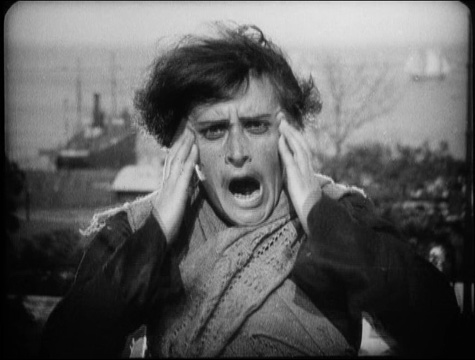
If anyone is ever curious about what German Expressionism is then look no further than The Cabinet of Dr. Caligari. The screenshot alone should be enough to explain that this film is highly stylized. It's considered to be a first for a certain narrative strategy, but you will have to watch it to find out what it is for yourself.
The Searchers is often hailed as the greatest western ever made but I really think Once Upon a Time in the West is the better film. One of the main reasons being that Once Upon a Time is actually entertaining. It is slow paced, but has great story telling with an excellent climax.
As I read Brave New World over the summer I thought to myself, "wow, this book must have really influenced Metropolis." Then I looked at the dates. It was the other way around. Metropolis has been monumentally influential on science fiction, with benchmarks such as being the first film to feature a robot.
50% of all film classes at least make mention of The Odessa Steps Sequence. Some find that other than that scene, the film is rather boring. I disagree, and find that Battleship in its entirety is thrilling and seeing the whole film only makes The Odessa Steps Sequence more effective.
It's nice that this film has been on Netflix for a while because that hopefully means it won't be leaving any time soon. I say this because anyone who watches it will probably want to watch it a second time. About 30 minutes into the film and you will understand why.
To me, this is to war films as The Texas Chainsaw Massacre is to horror films. Both create a world of absolute chaos, completely free of reason. Apocalypse Now may feature my favorite screenplay of any film. Both the written and improvised dialogue is hypnotic.
This is probably the quintessential example of Italian neorealism, which may be the most influential movement in the history of cinema. The film's plot is simple, but the emotions it conveys and the ideas it represents are anything but. Watch this movie.
Endings are a pretty important part of a movie. My TA for a script analysis course I took told me that the first act is inspiration and the third act/ending is the message you, the filmmaker, are trying to send. What constitutes a good ending is a matter of fun, interesting debate. A friend of mine argued the quality of Gladiator's ending by stating that when he and his friends watched the film one time they were talking and were distracted during most of the film. But once the last scene began to play, everyone was silent. This is certainly a strong argument but I do not think that is the only criteria necessary for a strong ending. I find that an ending's strength often times comes from its relationship to the narrative that has played out for the duration of the film. As an isolated scene, an ending may be weak, insignificant, and meaningless, but when seen after all the events that have just occurred, it is striking. I am not saying these are the best endings ever made, these are only my favorites. The ones that leave me satisfied, excited, or thinking. WARNING: THIS IS A LIST OF SPOILERS (DUR) IF YOU HAVE NOT SEEN THE MOVIE AND DO NOT WANT IT SPOILED THEN DO NOT READ THE BLURB ABOUT IT AND DO NOT WATCH THE CLIP
10. Rocky (1976)
Rocky is probably one of the greatest sports films ever made. For me, what makes Rocky (and other famous sports movies) so great is that it does not solely rely on the sport that is the subject of the film. Yes, Rocky is about a boxer, but I would argue that it is more a love story than a boxing story. Just look at this poster for the film. In it, we see the backs of Adrien and Rocky. If you look in the center of the picture you will see the two holding hands. I believe that this is evidence that the film is more a love story than one of boxing. The love story is further emphasized in the ending. The results of the fight are hardly audible and it is not really clear who won or what the conclusion of the fight was. What is clear, and what is audible, is the final lines between Rocky and Adrian.
9. Winter Light (1963)
This movie was already blowing my mind before the ending, but its final moments stabbed me deep in the gut. Bergman further demonstrates that he was an absolute film-making genius in these final moments. Specifically, I am referring to when Algot, the hunchbacked sexton, shares with Tomas, the pastor, his theory about Jesus' suffering. In this scene Bergman is able to paint the agony and suffering that Tomas must be going through. The decision to not have Tomas physically act his pain or verbally express it is brilliant, because I think that simply acting it would not be enough. Instead, drawing this connection to Christ and juxtaposing the two is infinitely more effective, with Tomas sitting there with a blank face. It's the Kuleshov Effect, but with words.
8. Glory (1989)
When I was younger and had this film on VHS I would rewind and re-watch the final moments of this film time after time after time. This is drama at its finest! We have these characters that we have become attached to throughout the film and all their efforts culminating in a single charge. Once Shaw dies and the music strikes my emotions go nuts, my heart pounds, and the hair on my neck rises. We lose two of the most prominent characters almost instantly and the viewers feel the rage and force of the 54th as they charge into Fort Wagner. We also see bits of character development with Trip and Thomas and this only adds to the excitement and tragedy of the scene.
7. Schindler's List (1993)
I was barely holding on throughout Schindler's List, trying as hard as I could to hold in my tears, but once the scene came, I was done for. After all he had done, after all the lives he had saved, after all he had sacrificed, Oscar Schindler still thought he could have done more. He looks at all of his remaining possessions and is ashamed of them. Why had he not sold the car? If one compares this Schindler to the one found at the beginning of the film the only similarity would be that of physical appearance. That is one of the most impressive parts about this film; Schindler has a massive arc, but the viewer can't point to a single moment in the film when he decided to become a hero. It is so gradual, and so human.
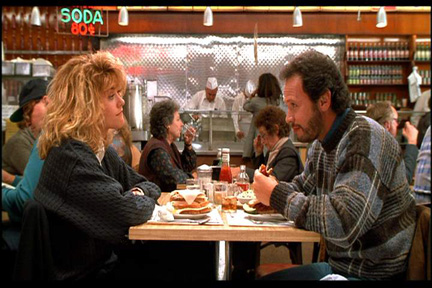
6. When Harry Met Sally (1989)
Ultimate goal in life? Living out this scene. Harry is defeated and alone, but he remembers all of the great times he has had with Sally. He remembers all the good, all the reasons he loves her, and all the reasons that make any argument they have had beyond trivial. Then there is his silly looking run; this can't wait he has to confess his love! He confronts Sally, spills his guts, gets rejected, then lays down one of my all-time favorite lines of any movie ever to seal the
deal. It is perhaps the single best line of dialogue of any romantic comedy. Right up there with the ending of Some Like it Hot. Sally even says she hates him right before he gives her a big hug. I find that so funny.
5. 2001: A Space Odyssey (1968)
Here is a classic WTF? ending. Although, much of what is actually happening to the character is pretty straight forward, the way in which Kubrick goes about showing it to the audience is mesmerizing, and not so straight forward. I watched it with a huge grin the first time I saw 2001; one, because it is nuts, and secondly, because I could just imagine people being so confused while watching this ending. For me, part of what makes this films so great is the massive amount of mystery surrounding it. The viewer is never entirely sure what is going on in the film and it all builds up to the viewer REALLY not knowing what is going on.
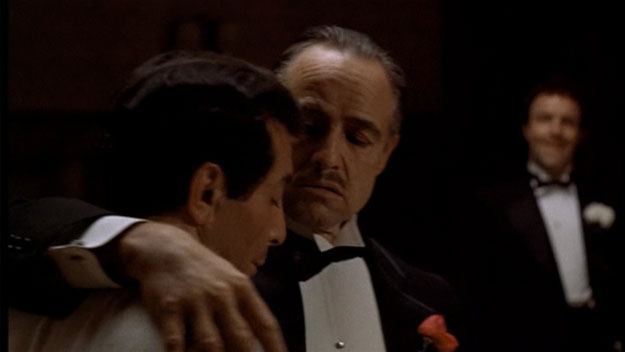
4. The Godfather (1972)
Most of the youtube comments for this scene revolve around the idea that this is the greatest ending in the history of cinema. It's certainly up there. Really, what is there to say about this ending and The Godfather that has not been said a bagilion times? The music, the acting, the cinematography, heck, even the editing is amazing! I love the swipe at the end to create the effect of the door closing. That may even be my favorite part of the ending. That, and Michael losing his cool for a second. With epics it sometimes seems hard to imagine an ending. After so much has happened how can this movie possibly end? Coppola manages to do so in a relatively calm and exceptionally effective way, by suggesting rather than flat out telling.
3. The Silence of the Lambs (1991)
Clarice did it! She solved the crime, stopped the bad guy, and got some FBI cake! All is over and happy now. There are no loose ends or anything to make anyone the least bit worried. Clarice, you got a phone call. Oh yeah... that guy. Hannibal the Cannibal is still out there, and is as charming and polite as ever. Jodie Foster has an amusing look of shock during this whole scene while Hopkins could not look more relaxed. Isn't it just great that he actually bothers to call her? He knows he won't be caught and just wants to have a little fun, promoting his intellect in the process. It's also interesting that a somewhat minor character (in terms of screen time) has the last line and is the final image. Walking down the street, looking oh so suave.
2. Paths of Glory (1957)
The power of the ending to Paths of Glory comes so much from the context of the whole story. Isolated, it does not really mean much, I don't think, and I can't really imagine anyone really giving it a second thought. But after watching the film, and seeing the cruelty that just unfolded amplifies the emotional effect of this scene. The men all start off acting obnoxious and wild, but once the woman (played by Kubrick's future wife) begins to sing they slowly calm down. What's next, is that they actually seem touched by the music, some even crying. Now they do hum along with her, but I wonder if they actually know what she is singing. They are French and she is speaking German. An American audience almost definitely won't know what the lyrics mean. I looked them up after a viewing and now the scene is even more effective.
Star Wars (1977)
I am such a huge sucker for this scene. I sit at the edge of my seat, with a big smile, heart pounding, and I know exactly what is going to happen. I've seen the film so many times, I have most of its entire dialogue memorized. It doesn't matter that I know exactly how this scene will play out, I still get excited and absorbed in it. For me, it is just SO exciting. Oh no! Vader is moving in! Luke you're doomed! "Let go Luke!", "hmm, the force is strong with this one.", "You turned off your targeting computer!" "I have you now!" BLAST! "yeeeehaaaaaa!!" HAN SOLO TO THE RESCUE! Does it get any better than that? Nope. The one flaw with the ending is that Chewie does not get a medal at the end.
Due to adjusting to school starting up, and all, I have not been able to make a list for about a month. So instead of working on Swahili I have decided to construct this list. I believe that opening credits offer the filmmaker a great opportunity to set the tone to his/her film and get the audience excited. I also believe that there should be an academy award fort opening credits (I think there used to be one). So here are my ten favorites. There are no James Bond movies on the list because I think that is a list in itself. Enjoy.
10. Enter the Dragon (1973)
I love how much the song hits you when this sequence starts up, due to how quietly the scene prior ends. Oh, and the song is awesome too.
9. Run Lola Run (1998)
Once this sequence began I knew that I had made a great choice in deciding to watch this movie. You should do the same.
8. The Big Gundown (1966)
Most would probably assume the Spaghetti Western I would have on this list would be The Good, The Bad, and The Ugly. WRONG! Instead I chose this masterpiece! Not many credits here but the images and music are certainly amazing.
7. Ghost in the Shell (1995)
I prefer the original version to the 2.0 one, but they are both great. Even the opening credits to Ghost in the Shell visually influenced The Matrix.
6. To Kill a Mockingbird: 1962
Youtube failed me by not having the actual on the site. So instead this guy will explain why it is so great.
5. 2001: A Space Odyssey (1968)
This opening is so iconic that even people who have not seen it, feel as if they actually have.
4. The Girl with the Dragon Tattoo (2011)
As I sat in the theater waiting for this film to begin I was hoping that the Karen O Trent Reznor/Atticus Ross cover of Immigrant Song would be in the film. My prayers were answered and then some.
3. Psycho (1960)
Every time when those first few notes I instantly become excited that I am about to see one of the greatest films ever made. Those stringed instruments just CUT into you, don't they?
2. Abbott and Costello Meet Frankenstein (1948)
I have indicated many times that I love monster movies. So to see the classics wonderfully animated with the names of actors such as Lon Chaney Jr. and Bela Lugosi in the same film together is a wish come true.
1. Enter the Void (2009)
I had no idea what I was getting myself into when I went to see Enter the Void solely off a recommendation from a friend. Then the credits began to roll and I had an idea of what I was about to experience, something I had never before.


-cover.jpg)